Blog with Caraway
Cake Pan Sizes: How To Pick the Right One for Any Recipe
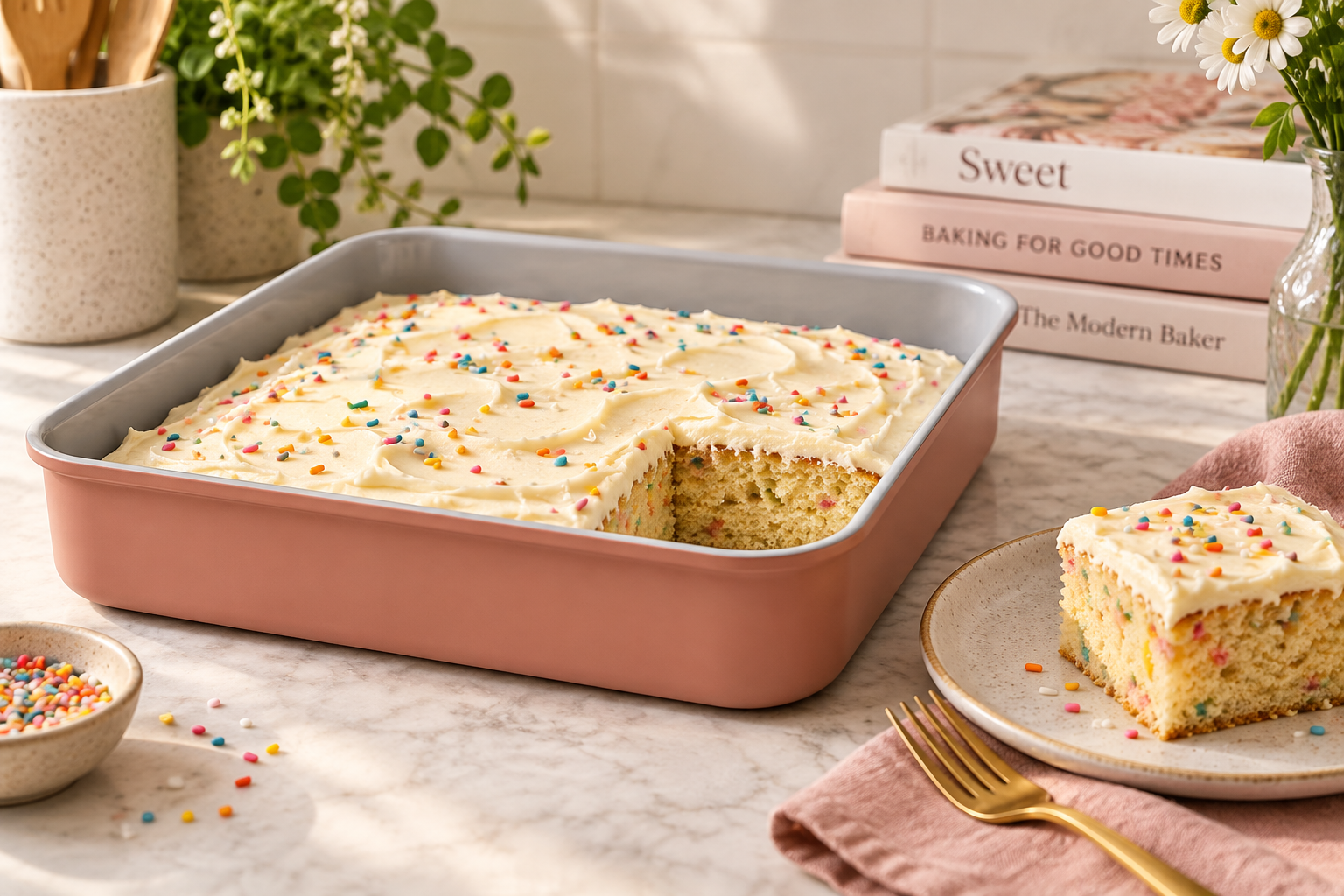
Key Takeaways:
Cake pans are matched by volume, not by the number stamped on the bottom, and an 8-inch square holds about the same amount as a 9-inch round.
Batter depth affects baking time, so a shallower pan finishes faster, and a deeper one needs longer at a lower temperature.
Filling a pan more than two-thirds full is the fastest route to an overflow or a sunken center.
Recipe developers pick a pan for a reason. They've already decided how tall the finished cake should be, how much crust forms on the edges, and how the crumb sets. The pan is part of the recipe, not a suggestion attached to it.
Two things change when you switch pans.
The first is batter depth. A fixed amount of batter spread into a wider pan sits in a shallower layer, so heat reaches the center faster. Pour that same batter into a narrower pan, and it sits deeper, meaning the outside sets long before the middle catches up.
The second is surface area. More surface means more evaporation and more browning around the edges. Less surface means a moister, softer crumb but a slower bake.
Get those two wrong, and you're not baking the recipe anymore. You're improvising.
Round, Square, or Sheet: Which Pan Should You Use?
Each shape behaves a little differently in the oven.
When Should You Use a Round Pan?

Round pans are the standard for layer cakes. With no corners, heat moves evenly around the perimeter, so the edges set at roughly the same rate as the center. That's what gives you a flat-ish top and a tender, uniform crumb.
Reach for round pans for birthday cakes, layer cakes, coffee cake, and anything you plan to frost and stack. Our 9" Circle Pan is the single most useful cake pan to own, and the Circle Pan Duo lets you bake both layers at once instead of waiting through two rounds.
When Should You Use a Square Pan?

Square pans hold noticeably more batter than round pans of the same size because those corners add real volume. They also give you clean, sliceable portions with zero waste, which is exactly what you want for bar-style desserts.
Use a square pan for brownies, blondies, cobblers, crumbles, cornbread, and snacking cakes. The tradeoff is those same corners: they receive heat from two directions and can overbake if you're not paying attention. Our 9" Square Pan handles all of the above.
When Should You Use a 9x13 or Sheet Pan?

The 9x13 is the feed-a-crowd workhorse. It bakes a single flat layer that you can frost right in the pan and cut into squares, which means no stacking, no crumb coat, and no cake-flipping anxiety.
Use it for sheet cakes, big-batch brownies, bar cookies, and anything headed to a potluck. Our 9x13" Rectangle Pan is the standard size nearly every sheet cake recipe assumes.
What Are the Most Common Cake Pan Sizes?
Here's what each size actually holds, measured as total capacity to the brim. Depth matters as much as diameter, so these assume the modern 2-inch standard.
Round pans:
6 x 2 inches holds about 4 cups
8 x 2 inches holds about 6 cups
9 x 2 inches holds about 8 cups
10 x 2 inches holds about 11 cups
Square pans:
8 x 8 x 2 inches holds about 8 cups
9 x 9 x 2 inches holds about 10 cups
Rectangular pans:
11 x 7 x 2 inches holds about 10 cups
9 x 13 x 2 inches holds about 14 cups
Loaf pans:
8½ x 4½ inches holds about 6 cups
9 x 5 inches holds about 8 cups
Two things jump out of that list. First, an 8-inch square and a 9-inch round hold nearly identical volume , right around 8 cups. That's the single most useful swap in baking.
Second, pan depth changes everything: a 9-inch square at 1½ inches deep holds about 8 cups , while the same pan at 2 inches deep holds about 10 cups. Always measure depth, not just width.
How Does Pan Size Affect Bake Time?
Once you've matched volume, bake time is the other half of the equation, and it comes down to how deep your batter sits.
Shallower batter bakes faster. Moving a recipe into a wider pan means heat hits the center sooner. Start checking about 25 percent earlier than the recipe says.
Deeper batter bakes slower. A narrower or taller pan means the center takes longer to set while the edges keep cooking. You'll need extra time and a lower temperature, so the outside doesn't overbake first.
The standard adjustment: drop the oven temperature 25°F and extend the time when going deeper, or raise it 25°F and shorten the time when going shallower . Either way, test with a toothpick rather than trusting the original timer.
What Happens If You Use the Wrong Size Pan?
Both directions fail, just differently.
Too small, and you've overfilled. Batter climbs the sides, spills over the rim, and burns onto the oven floor. What stays in the pan bakes unevenly: set edges, gummy middle, and often a collapsed center once it cools. Overfilling is also the most common cause of that dense, sunken crater in the middle of an otherwise fine cake.
Too big, and the batter spreads thin. It bakes fast, dries out, browns hard at the edges, and comes out a fraction of the height you expected. Frosting a half-inch-tall layer cake is its own kind of disappointment.
The guardrail is simple: fill any cake pan between one-half and two-thirds full. Never more. If you've got extra batter, bake it as cupcakes rather than forcing it into the pan.
How Do You Substitute One Cake Pan for Another?
Match total volume first, then adjust time. Here are the swaps that work cleanly with no recipe changes:
One 9-inch round swaps for one 8-inch square, both around 8 cups
Two 8-inch rounds swap for one 9x13 pan, both around 12 to 14 cups
One 9-inch square swaps for one 11x7 pan, both around 10 cups
One 8-inch round swaps for one 8½ x 4½ loaf pan, both around 6 cups
One 9x5 loaf pan swaps for one 9-inch round, both around 8 cups
One 9x13 pan swaps for two 9-inch rounds or three 8-inch rounds
Any 6-cup batter swaps into a 12-cup muffin pan for 12 to 16 cupcakes
Cupcakes are the underrated escape hatch here. Almost any cake batter bakes well in a muffin pan, and it takes about 18 to 22 minutes rather than 30 to 40.
A few swaps that don't work: jelly roll and sponge cakes need their exact pan because they're rolled, and angel food or chiffon cakes need an ungreased tube pan to climb the sides. Those aren't flexible.
Does Pan Material Change Anything?
It does, and it's the variable people forget after they've done all the volume math.
Color matters most. Dark pans absorb heat more efficiently than light-colored ones , which browns food faster. That's useful for a crisp pizza crust and a problem for a delicate cake, where you'll get dark edges before the center finishes. If your pans run dark, drop the temperature 25°F.
The core matters, too. Aluminized steel conducts heat quickly and evenly, which is why it's what most professional bakers use. Glass and stoneware heat slowly and hold that heat afterward, so bakes often run longer and keep cooking once they're out of the oven.

Every pan in our Cake, Pie & Bundt Pans collection is built on an aluminized steel core with a ceramic coating free of PFAS, PTFE, PFOA, lead, and cadmium, and every piece is third-party tested.
Frequently Asked Questions
How do I measure a cake pan correctly?
Measure the diameter across the top inside edge, rim to rim, not the bottom, since most pans taper slightly. For depth, measure from the inside bottom straight up to the rim. Those two numbers are what any conversion depends on.
Can I use a 9-inch pan instead of an 8-inch pan?
Yes, with a caveat. A 9-inch round holds roughly two cups more than an 8-inch, so the same batter sits shallower and produces a thinner layer. It'll bake faster, so start checking about five to eight minutes early. For a layer cake where height matters, consider scaling the recipe up by about 25 percent.
How full should I fill a cake pan?
Between one-half and two-thirds full. Cakes need headroom to rise, and anything past two-thirds risks spilling over or collapsing in the middle. Extra batter becomes cupcakes.
Why did my cake sink in the middle?
Overfilling is the most common culprit, since too-deep batter can't set in the center before the structure gives out. Other causes include opening the oven door too early, underbaking, or excessive leavening. If you recently switched pans, start there.
Does the pan shape change how a cake tastes?
Not the flavor, but the texture, yes. Corners on square and rectangular pans get more direct heat and bake up slightly firmer and chewier, which is exactly why brownie fans fight over edge pieces. Round pans give you a more uniform crumb throughout.
Sources:
Why the Size of Your Baking Pan Matters So Much | King Arthur Baking
In a Pinch: Food Yields, Baking-Pan Sizes | University of Missouri Extension