Spend $675 to unlock your gift!
$0
$90
Free Shipping
$675
Baking Sheet Duo
($120 Value)
Your Cart is Empty
Get started with the Caraway essentials!
Free Shipping On Orders $90+
Free Returns
30-Day Trial
Home & Kitchen with Caraway

Key Takeaways:
Research has found that bacteria struggle to survive on wood surfaces, while the knife grooves in plastic boards can trap and harbor bacteria over time.
Plastic cutting boards shed microplastics into your food as you chop, a concern that's driven many home cooks toward natural materials.
Wood boards are gentler on your knives and last for years with proper care, making them a durable, kitchen-friendly choice.
The wood-versus-plastic cutting board debate is one of those kitchen questions that seem simple until you actually dig into it. For years, plastic was considered the more hygienic choice because it's dishwasher-safe and easy to sanitize. But new research has complicated that story, and many home cooks are taking a fresh look at what's actually touching their food every day.
At Caraway , we care about the surfaces you prep on just as much as the ones you cook on. So, let's cut through the noise and look at what the research actually says about bacteria, microplastics, durability, and knife care, so you can decide which board belongs in your kitchen.
This is where most people expect plastic to win, and for decades, that was the assumption. Plastic seems more hygienic because it's nonporous and can be run through the dishwasher. But the actual science tells a more interesting story.
In landmark research on cutting board safety, microbiologists found that bacteria applied to wood surfaces didn't survive well and couldn't be recovered, seemingly absorbed into the wood and dying off. On plastic boards, the bacteria survived on the surface and could be recovered, especially once the boards developed knife grooves from regular use.
Those grooves turned out to be a real problem: bacteria settled into the cut marks where they were much harder to clean away, even with washing. The takeaway is that wood's natural properties appear to work against bacterial survival in a way plastic doesn't.
A brand-new plastic board and a wood board perform similarly, but once a plastic board is scratched and scored from months of chopping, those grooves become tough-to-clean hiding spots. That said, this doesn't mean you can skip cleaning a wooden board. Any cutting board that comes into contact with raw meat, poultry, or seafood needs to be washed properly.
According to USDA food safety guidance , boards should be cleaned after each use and discarded once they develop hard-to-clean grooves, regardless of material. The difference is that wood tends to age more gracefully on the bacteria front.
Here's a factor that wasn't part of the conversation a decade ago but has become a major reason people are rethinking plastic: microplastics. Every time you drag a knife across a plastic cutting board, you're shaving off tiny particles of plastic, and some of those end up in your food.
Recent research examining cutting boards as a source of microplastics found that chopping on plastic boards can release tens of thousands of microplastic particles into food over time, with harder foods like carrots generating even more particles because they require more force to cut.
The long-term health effects of ingesting microplastics are still being studied, but it's an area of growing concern. Microplastics have been detected throughout the human body, and researchers are actively investigating their potential links to inflammation and other health issues.
Wood boards, by contrast, don't shed microplastics. When a wooden board wears down, what comes off is simply wood fiber, not synthetic polymer. For many health-conscious cooks, that alone tips the scales.
If you've ever noticed your knives dulling faster than they should, your cutting board might be the culprit. This is a category where wood has a clear, practical advantage.
When your knife blade strikes the surface, the wood yields slightly, which cushions the edge and helps keep it sharp longer. Hard plastic boards offer less give and can wear down a knife's edge more quickly.
There's a reason professional kitchens and serious home cooks tend to favor wood boards, and knife care is a big part of it. A quality wood board treats your good knives gently, which means less frequent sharpening and a longer life for your blades. If you've invested in a nice knife set, the surface you cut on genuinely matters.
Our
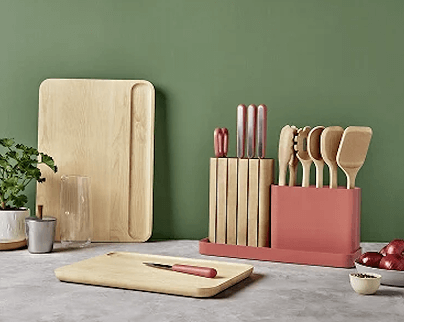
Cutting Board Set is made from FSC-certified birch wood, offering the ideal balance of firmness and give. It's sturdy enough to handle daily chopping while staying gentle on your knife edges, so your blades stay sharper between sharpenings.
A good cutting board is an investment, and how long it lasts is part of its value.
Wood boards, when properly cared for, can last for years and even decades. They can be sanded and re-oiled to refresh the surface so that a quality wood board can outlive many other kitchen tools. There's a reason people hand down well-loved wood boards: they genuinely stand the test of time.
Plastic boards are cheaper upfront, but they wear out faster. Once they're deeply scored with knife marks, they become harder to clean and need replacing. That means buying new boards more often, which adds up over time both financially and in terms of waste.
Wood does require a bit more care to reach that long lifespan, but it's minimal. A periodic rub with food-safe mineral oil keeps the wood conditioned and prevents it from drying out or cracking. That small maintenance step is what allows a wooden board to last for years.
Here's something worth knowing, regardless of which material you prefer: food safety experts recommend using separate cutting boards for different types of food.
The USDA suggests keeping raw meat, poultry, and seafood on separate boards from produce and ready-to-eat foods to prevent cross-contamination. This is one of the simplest ways to reduce risk in your kitchen. When raw chicken juices and the apple you're slicing for a snack never touch the same surface, you've eliminated a common contamination path.
This is where having a set of boards in different sizes really pays off. Our Cutting Board Set comes in three sizes, so you can dedicate each board to a different task: a large one for breaking down proteins, a medium for everyday prep, and a small one for slicing fruit or herbs.
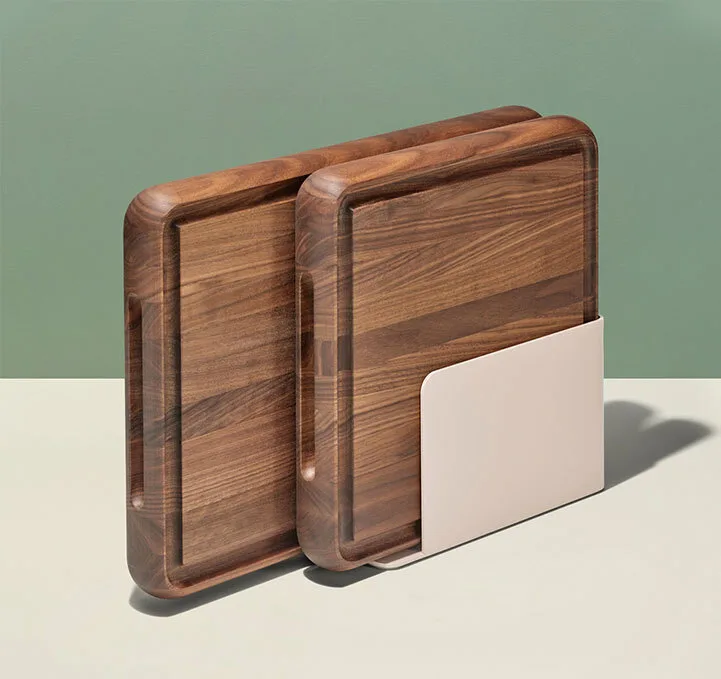
For heavier-duty prep, our Prep & Serve Butcher Block Set offers thick, substantial boards that double as serving pieces, perfect for when you're prepping and entertaining at the same time.
Wood's main "downside" is that it needs a little care, but it's genuinely simple.
Here's how to keep a wooden board in great shape for years:
Hand wash, don't soak. Wash your board with warm, soapy water after each use, using a sponge or soft brush to remove debris. Avoid soaking it or running it through the dishwasher, since excessive moisture can cause wood to warp or crack.
Dry it right away. Towel-dry the board and let it finish air-drying upright so moisture doesn't sit on the surface.
Oil it regularly. Every few weeks, or whenever the wood looks dry, rub in a food-safe mineral oil to condition the wood, prevent cracking, and keep the surface easy to clean.
Sanitize when needed. After cutting raw meat, you can sanitize it with a diluted solution. For stubborn stains or odors, a scrub with coarse salt and half a lemon works well on wood.
Replace when worn. Even wood boards don't last forever. If yours develops deep grooves or cracks that trap food, it's time for a new one.
Research suggests wood boards resist bacteria better as they age, since bacteria don't survive well on wood surfaces, while plastic boards can trap bacteria in knife grooves over time. That said, both need proper cleaning after every use, and any board with deep, hard-to-clean grooves should be replaced regardless of material.
Yes. Studies have found that chopping on plastic cutting boards releases microplastic particles into food, with the amount increasing when cutting harder foods that require more force. Wood boards don't have this issue, since any wear produces wood fiber rather than plastic particles.
Wood is gentler on knife edges because it has a slight give that cushions the blade as it strikes the surface. Hard plastic boards offer less give and can dull knives faster, which is why many cooks who own quality knives prefer wood.
Sources:
Antimicrobial Properties of Wood Cutting Boards (Cliver Research) | PubMed
Microplastic Release from Consumer Products Including Cutting Boards | PMC
Cutting Boards and Food Safety | USDA Food Safety and Inspection Service
Forever Chemicals and Microplastics: What to Know | Cleveland Clinic
Spend $675 to unlock your gift!
$90
Free Shipping
$675
Baking Sheet Duo
($120 Value)
Get started with the Caraway essentials!
Free Shipping On Orders $90+
Free Returns
30-Day Trial
Spend $675+ to unlock your free gift!
Exclusive Baking Sheet Duo for orders $675+
$90
Free Shipping
$675
Baking Sheet Duo
($120 Value)
Spend $675+ to unlock your free gift!
Exclusive Baking Sheet Duo for orders $675+
$90
Free Shipping
$675
Baking Sheet Duo
($120 Value)
