Your Cart is Empty
Get started with the Caraway essentials!
Free Shipping On Orders $90+
Free Returns
30-Day Trial
Home & Kitchen with Caraway
Key Takeaways
A saucepan is best for simmering, boiling, and hands-off cooking, while a saucier shines when constant stirring or whisking is key.
The curved sides of a saucier make sauces smoother and easier to manage, while the straight sides of a saucepan help contain liquids and reduce splatter.
For most home cooks, a 2-quart saucepan and a 2-quart saucier cover nearly all everyday cooking needs without cluttering the kitchen.
If you’ve ever stood in your kitchen holding a saucepan and wondering why a recipe specifically calls for a saucier, you’re not alone. They look similar, they live in the same cabinet, and they both handle sauces, so what’s the real difference?
At Caraway , we’re big on choosing tools that actually make cooking easier, not more confusing. The good news is this: once you understand how a saucepan and a saucier are shaped and how that shape affects cooking, it becomes very obvious when each one shines.
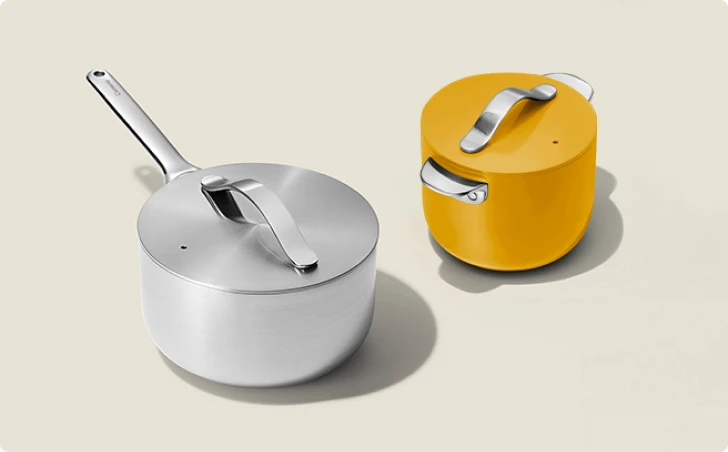
A saucepan is the straight-sided staple most of us grew up with . It has tall, vertical walls, a flat bottom, and usually comes with a lid. That structure is intentional.
Those straight sides help trap heat and reduce evaporation, which makes a saucepan ideal for liquids that need time and consistency. The flat base sits evenly on the burner, promoting reliable heat distribution, especially when cooking grains or reheating leftovers.
In everyday life, saucepans handle more than sauces. They’re workhorses for oatmeal, rice, quinoa, pasta water, soups, canned beans, and small batches of broth. If it’s something you set and stir occasionally, a saucepan is usually the right call.
A saucier is all about movement. Instead of straight sides, it has gently sloped, curved walls that flow seamlessly into the base. That curve is the entire point .
The rounded shape makes it much easier to whisk, stir, and emulsify without ingredients getting stuck in corners. Sauciers heat evenly and respond quickly, which is exactly what you want when working with dairy, eggs, or delicate reductions.
This is the pan you reach for when timing and texture matter. Cream sauces , custards, risotto, polenta, pastry cream, lemon curd, and gravy all benefit from the smooth interior and constant motion a saucier allows. Less sticking, fewer hot spots, and better control overall.
The easiest way to decide between the two is to ask how the food behaves while cooking.
If the recipe involves frequent whisking, stirring, or thickening, a saucier makes life noticeably easier. You can reach every inch of the pan without scraping, which helps prevent scorching and uneven texture.
If the recipe is more hands-off, relies on liquid volume, or needs a lid, the saucepan wins. Straight sides mean better containment and less splatter, which matters when you’re boiling, simmering, or reheating.
At Caraway , we think of them as complementary, not competitive. Most home cooks benefit from having one of each in the right sizes.
You don’t need every size under the sun. A few well-chosen options cover almost everything.
For saucepans, a 2-quart size is ideal for daily tasks like reheating soup, making grains, or warming sauces. If you cook for more than one or like batch cooking, adding a 3-quart gives you extra breathing room without feeling bulky.
For sauciers, a 2-quart is the sweet spot. It’s large enough for whisking sauces or cooking risotto, but still manageable for everyday use. Bigger sauciers exist, but unless you’re cooking for a crowd, this size handles most needs beautifully.
Our stainless steel cookware is designed to feel balanced and responsive at these sizes—sturdy enough for control, light enough for daily cooking, and made with clean materials you can feel good using every day.
If you cook often, yes. A saucepan handles everyday liquids while a saucier excels at whisked and delicate recipes.
You can, but whisking is harder and sauces are more likely to stick in the corners.
Not at all. It’s great for risotto, oatmeal, polenta, custards, and anything that needs constant stirring.
A saucepan is better because of its straight sides and ability to hold more water.
Sources:
Saucepan definition | The Cambridge English Dictionary
What’s the Difference Between Saucepans and Sauciers? | Serious Eats
Rich and Easy Cream Sauce Recipe with Variations | The Spruce Eats
Get started with the Caraway essentials!
Free Shipping On Orders $90+
Free Returns
30-Day Trial