Your Cart is Empty
Get started with the Caraway essentials!
Free Shipping On Orders $90+
Free Returns
30-Day Trial
Home & Kitchen with Caraway
Key Takeaways
Mise en place is not about extra bowls. It’s about prepping only what needs to be ready before the heat is on.
The easiest system is stage-based prep plus one cutting board and a simple hold zone to avoid extra dishes.
Better prep creates calmer cooking, which helps you control heat, timing, and flavor without rushing.
If you’ve ever watched a cooking show and thought, “Sure, that looks calm… but who washed all those tiny bowls?” you’re not alone.
Mise en place, the French idea of prepping everything before you cook, gets a reputation for being fussy, dish-heavy, and unrealistic for everyday life. But at its core, it’s not about perfection or restaurant rules. It’s about cooking with intention, staying organized, and avoiding that mid-recipe panic where something burns because you’re still chopping.
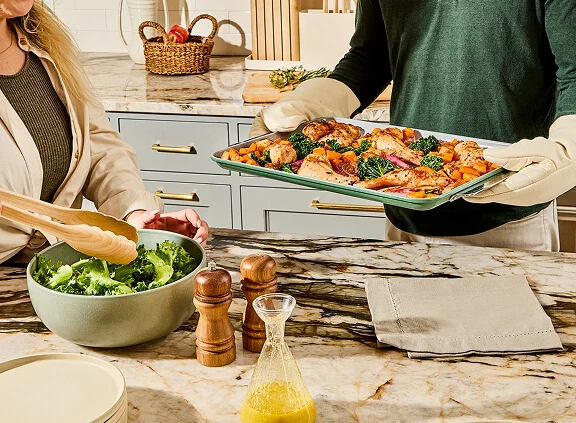
At Caraway , we believe mise en place should work for real life, not against it. Less scrambling. Fewer dishes. Cleaner cooking. And a kitchen that feels calmer instead of chaotic.
At its simplest, mise en place means “everything in its place.” That’s it.
It does not mean:
Prepping every ingredient into a separate bowl
Owning dozens of tiny dishes
Cooking like a professional line chef
Adding more cleanup to your life
What it does mean is making small, intentional prep decisions so cooking flows smoothly from start to finish. In real life, mise en place is about timing, order, and knowing what needs to be ready before the heat is on.
Once the stove is on, things move fast. Oils heat. Garlic browns. Proteins sear. If you’re still slicing or measuring at that point, stress sneaks in.
Mise en place helps because it:
Prevents burning and overcooking
Reduces rushed decisions
Makes cooking feel calmer and more controlled
Keeps you from multitasking too hard
Leads to better flavor and texture
And from a health perspective, it helps you cook more intentionally . You’re less likely to overheat oils, oversalt in a panic, or abandon a dish halfway through because it feels overwhelming.
Here’s the mindset shift that makes mise en place sustainable: Not everything needs to be prepped at the same time.
Instead of prepping everything, ask:
What goes into the pan first?
What cooks fast?
What can wait 5 minutes?
For example:
Onions and proteins usually need to be ready early
Garlic, herbs, and acid can often wait
Sauces can be measured while something simmers
You don’t need a separate board for every ingredient. You just need order.
A simple system:
Prep vegetables first
Prep aromatics next
Prep raw proteins last
Wash once
Scrape ingredients into piles on the board or slide them directly into the pan when ready. This alone eliminates half the bowls people think mise en place requires. A sturdy, easy-to-clean cutting surface makes this even smoother, especially one that doesn’t slide around or absorb odors.
Instead of bowls, create hold zones :
The corner of your cutting board
A plate you’ll already use
A pan that’s not heated yet
Example: If you’re cooking in stages, your sauté pan can double as a holding area before it hits the burner. No extra dish required.
This works especially well with non-stick ceramic cookware , where ingredients release easily, and clean-up stays simple.
To keep your countertops tidy as you prep and reduce the need for extra dishes or piles of tools, a sleek, stackable spoon rest like Caraway’s non-toxic, non-slip design lets you park utensils between stages and contain drips for easier cleanup — a small tool that makes mise en place feel even more effortless.
Restaurant mise en place is ingredient-based . Home mise en place works better when it’s stage-based .
Think in phases:
Phase 1: What hits the pan first
Phase 2: What follows quickly
Phase 3: Finishing elements
This lets you prep in waves instead of all at once, which feels much more manageable on a weeknight.
Start small:
Try it with one recipe a week
Prep just the first cooking stage
Use fewer bowls each time
Over time, it becomes instinctive. You’ll cook faster, cleaner, and with more confidence without feeling like you’re performing.
Mise en place isn’t about perfection, but intention.
It’s chopping before heating, reading the recipe once, knowing what comes next, and setting yourself up for success with tools that simplify instead of complicate.
At Caraway , we design kitchenware that supports this exact rhythm. Because when your kitchen works better, cooking feels better, and that’s the whole point.
It literally means “everything in its place,” but in real life it just means doing the few prep steps that prevent chaos once the heat is on, like chopping the onion before you start sizzling oil.
No. That’s the internet version. One cutting board plus a “hold zone” like a plate, the corner of your board, or an unheated pan is usually more than enough.
Prep in order of use and keep it minimal: pile ingredients on your cutting board, slide them straight into the pan when it’s time, and reuse the same measuring spoon or cup when you can.
Read the recipe once, prep only what hits the pan first, and group ingredients by cooking stage, not by “all veggies in one bowl, all spices in another.”
Only what you can’t reasonably do while something cooks. If garlic goes in six minutes later, it does not need to be chopped at minute zero.
That’s exactly when mise en place helps most. Prep in waves, keep one clear “work lane,” and use your cutting board as the main station instead of spreading out.
Sources:
What Is Mise en Place and Why Is It So Important to Chefs? | Escoffier
Use "Mise en Place" to Make Meal Preparation Easier | UNL Food | Nebraska
Get started with the Caraway essentials!
Free Shipping On Orders $90+
Free Returns
30-Day Trial