Your Cart is Empty
Get started with the Caraway essentials!
Free Shipping On Orders $90+
Free Returns
30-Day Trial
Home & Kitchen with Caraway
Key Takeaways
PFAS is a large chemical family, and PTFE and PFA are just two members inside it.
PTFE and PFA are different materials, but both still count as PFAS.
The safest cookware alternatives are PFAS-free options like ceramic, stainless steel, and enameled cast iron.
If you’ve ever tried to make a healthier cookware choice and ended up swimming in alphabet soup, you’re not alone. Most people just want a pan they can trust that cooks well, cleans easily, and doesn’t introduce mystery chemicals into dinner.
But the world of nonstick coatings is packed with acronyms, half-answers, and labels that look reassuring until you realize they don’t actually tell you what’s inside.
At Caraway , we believe you deserve straight, simple information about what’s in your cookware and why it matters, especially when you’re trying to avoid PFAS chemicals altogether. That’s why we’re breaking down the relationship between PTFE and PFA in the way it should have been explained all along: clearly, calmly, and without the confusion.
Cookware conversations get confusing because people use these acronyms interchangeably, but they’re not the same thing. Think of it like this: PFAS is the big family, and PTFE and PFA are specific members inside that family.
PFAS (per- and polyfluoroalkyl substances) are a massive group of synthetic chemicals known for resisting water, grease, and heat . They’re often called “forever chemicals” because they don’t easily break down, which means they can linger in the environment and build up over time.
You’ll find PFAS in places you may not expect:
nonstick cookware
stain-resistant fabrics
waterproof jackets
fast-food wrappers
certain beauty products
If a material repels oil, water, or messes unnaturally well, PFAS are often involved. The key thing to know: PFAS is an entire category of thousands of chemicals with similar structures and concerns.
PTFE (polytetrafluoroethylene) is one specific type of PFAS, and it’s the most common nonstick coating used in traditional cookware . Teflon® is the most famous brand name, but PTFE is the actual material.
In simple terms, PTFE is a plastic-like coating that becomes extremely slippery when applied to pans, which is why eggs glide, pancakes flip, and cleanup stays easy. It became popular because it offered convenience, durability, and a smoother cooking experience than stainless steel.
But here’s the catch:
PTFE starts to degrade at temperatures above ~500°F (260°C). That can happen faster than most people realize, especially with an empty pan on high heat or broiling.
Once it breaks down, PTFE can release fumes. These fumes aren’t something you can see or smell, which is what makes them tricky.
Overheating is more common than cookware brands admit. Preheating on high, forgotten pans, or ovens that run hot can push PTFE past its limit in minutes.
So the short version: PTFE = a PFAS-based nonstick coating.
PFAs (not to be confused with PFAS, the category) are a specific subset of fluoropolymers related to PTFE but not identical . They have a slightly different chemical structure that makes them easier to mold or shape, so they’re often used in industrial applications like:
semiconductors
chemical tubing
specialized wiring and insulation
lab equipment
Some cookware brands have used PFA coatings as an alternative to PTFE, but the important truth is:
PFA is still a PFAS chemical.
It carries the same category-level concerns.
Even though it shows up less frequently in consumer products, it still belongs to the same “forever chemical” family, which is why people looking for PFAS-free cookware shouldn’t consider PFA coatings a safer swap.
Here’s the clean, definitive answer: PTFE and PFA are not the same, but they’re both part of the PFAS family. They share similar traits but show up in different places and behave slightly differently.
Both PTFE and PFA are fluorinated polymers , which means they’re made with carbon-fluorine bonds. That’s why they’re incredibly slippery, heat-resistant, and chemically stable. These shared traits are exactly what made PFAS coatings so appealing in cookware and industrial use for decades.
PTFE is rigid, which makes it great as a durable coating (like the classic nonstick layer on a pan). PFA has a slightly different structure that makes it more flexible and easier to mold, which is why it’s used more in industrial tubing, wiring, and specialty parts rather than home cookware.
PFA also has a higher melting point and handles extreme chemical environments better than PTFE. PTFE, meanwhile, is more common in consumer goods and degrades when temperatures creep past roughly 500°F, something most people don’t realize until their pan starts smoking.
Safety is the question everyone eventually gets to, and for good reason. PFAS have been under intense scrutiny in everything from water systems to makeup, and cookware is often part of that conversation.
Here’s what matters most for home cooks, explained simply and without the chemistry jargon.
PTFE itself is stable at normal cooking temperatures, which is why it became popular in the first place. But the concern isn’t “everyday use”—it’s overheating, and how easily that can happen in a real-world kitchen.
So while PTFE is considered “safe when used correctly,” the margin for error is small, and most home kitchens aren’t run like controlled labs. That’s a big part of why so many people (like our community at Caraway) move toward PFAS-free alternatives that remove the guesswork entirely.
PFAS regulations are evolving fast, but not always in ways consumers can easily decode.
Here’s the simplest way to understand where things stand:
PFAS scrutiny is increasing globally. The U.S., EU, and multiple states are tightening rules around PFAS in water systems, food packaging, textiles, and consumer goods.
“PFAS-free” labels are not always straightforward. There are thousands of PFAS chemicals. Some brands mean “free of the most studied PFAS,” others mean “free of PTFE and PFOA,” while a few truly mean “free of all PFAS.”
Cookware is one of the most confusing categories. Some products labeled “PFOA-free” still use PTFE. Some labeled “PFAS-free” exclude PTFE but include other fluoropolymers. And some use obscure PFAS substitutes that sound safe but aren’t.
That’s why Caraway takes the clearest, strongest stance: No PTFE. No PFA. No PFAS. Just clean, modern ceramic that performs beautifully without relying on forever chemicals.
There are several cookware styles that deliver incredible results without relying on fluorinated coatings, and many of them genuinely make cooking easier, not harder.
Here’s a simple guide to the best PFAS-free alternatives.
Ceramic-coated cookware has quickly become the leading alternative to PTFE for one major reason: it delivers nonstick performance without using any fluorinated chemicals.
Instead of PFAS, these pans use a smooth, mineral-based ceramic coating that releases food easily, cleans quickly, and doesn’t degrade into fumes at high temperatures.
People love ceramic cookware because:
It’s completely PFAS-free.
You still get that butter-smooth release that makes eggs glide.
It doesn’t break down into chemical fumes if accidentally overheated.
It cooks evenly and cleans up with minimal effort.
This is where Caraway really shines. Our cookware is built around non-toxic, PFAS-free ceramic that feels modern, performs beautifully, and looks good enough to live on your stovetop.
Stainless steel is a longtime favorite for cooks who want durability, versatility, and zero coatings of any kind. It contains no PFAS and can last decades with proper care.
Where stainless steel excels:
High-heat searing: unmatched browning and caramelization.
Boiling and simmering: perfect for pastas, soups, stocks, and reductions.
Oven safety: can go from stovetop to oven seamlessly.
Food can stick if the pan isn’t preheated properly or if the heat is too low, but once you understand heat control and timing, stainless steel becomes one of the most reliable, PFAS-free tools in your kitchen.
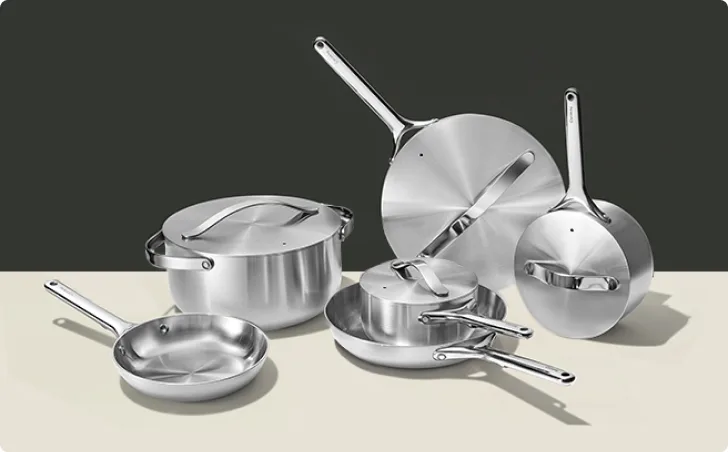
Our Stainless Steel cookware was designed for this exact purpose, with clean materials, beautiful construction, and reliable performance without coatings or chemicals.
Cast iron is naturally PFAS-free and nearly indestructible. A well-seasoned traditional cast iron skillet becomes naturally nonstick over time, making it a favorite for high-heat searing, frying, baking, and oven-to-table cooking.
Where it shines:
Handles very high heat (grilling, broiling, campfire cooking).
Naturally nonstick once seasoned.
Adds great flavor and browning to food.
Enameled cast iron takes it one step further:
No seasoning required.
Smooth, easy-to-clean surface.
Still PFAS-free, still incredibly durable.
Safe for acidic foods.
This is exactly why Caraway created our Enameled Cast Iron Dutch Oven . It gives you the heat retention, beauty, and heirloom feel of cast iron without the maintenance or PFAS concerns.
No. PTFE and PFA are different chemicals, but both belong to the PFAS family. If you’re trying to avoid PFAS altogether, you’ll want to avoid both.
Yes, high-quality ceramic coatings contain no PTFE, no PFA, and no fluorinated chemicals at all. That’s why they’ve become a top choice for health-forward kitchens (including ours at Caraway).
If you want nonstick without PFAS, ceramic-coated cookware is the easiest, safest swap. It stays slick, cooks evenly, and avoids all fluorinated chemicals.
Sources:
Polytetrafluoroethylene | ScienceDirect Topics
Scientists Dig Into Hard Questions About The Fluorinated Pollutants Known As PFAS | NPR
Get started with the Caraway essentials!
Free Shipping On Orders $90+
Free Returns
30-Day Trial