Spend $675 to unlock your gift!
$0
$90
Free Shipping
$675
Baking Sheet Duo
($120 Value)
Your Cart is Empty
Get started with the Caraway essentials!
Free Shipping On Orders $90+
Free Returns
30-Day Trial
Home & Kitchen with Caraway
Key Takeaways:
The best baking sheets are made from heavy-gauge aluminized steel, which heats evenly and resists the warping that ruins cheap pans.
Coating, color, and size all affect how your food bakes, so matching the pan to how you actually cook matters more than price alone.
A ceramic-coated surface gives you easy release and simple cleanup without the PFAS, PTFE, or PFOA found in traditional nonstick.
A good baking sheet is one of those kitchen workhorses you don't think much about until yours warps in the oven or your cookies come out burnt on one side and pale on the other.
It's easily the most-used pan in most kitchens, pulling duty for everything from sheet pan dinners to roasted vegetables to a weekend batch of chocolate chip cookies. And yet most of us just grab whatever's cheapest and hope for the best.
At Caraway , we think the tools you reach for every single day deserve more thought. A quality baking sheet genuinely changes how your food turns out, and the good news is that knowing what to look for isn't complicated.
Let's walk through everything that actually matters before you buy.
The material your baking sheet is made from is the single biggest factor in how it performs. It determines how evenly your food cooks, whether the pan warps under high heat, and how long the thing lasts before you're back shopping for a replacement.
Here's the quick rundown of what you'll find on shelves:
Aluminum heats up fast and conducts heat beautifully, which is why it's a longtime favorite for even browning. The catch is that thin, uncoated aluminum can react with acidic foods, and cheaper versions warp easily.
Stainless steel is durable and non-reactive, but on its own, it's actually a poor heat conductor, which can lead to uneven baking and hot spots.
Aluminized steel is the sweet spot, and it's what most professional bakers reach for. It's steel coated with an aluminum-silicon alloy, so you get the even, responsive heating of aluminum with the strength and warp resistance of steel. This is the construction worth prioritizing.
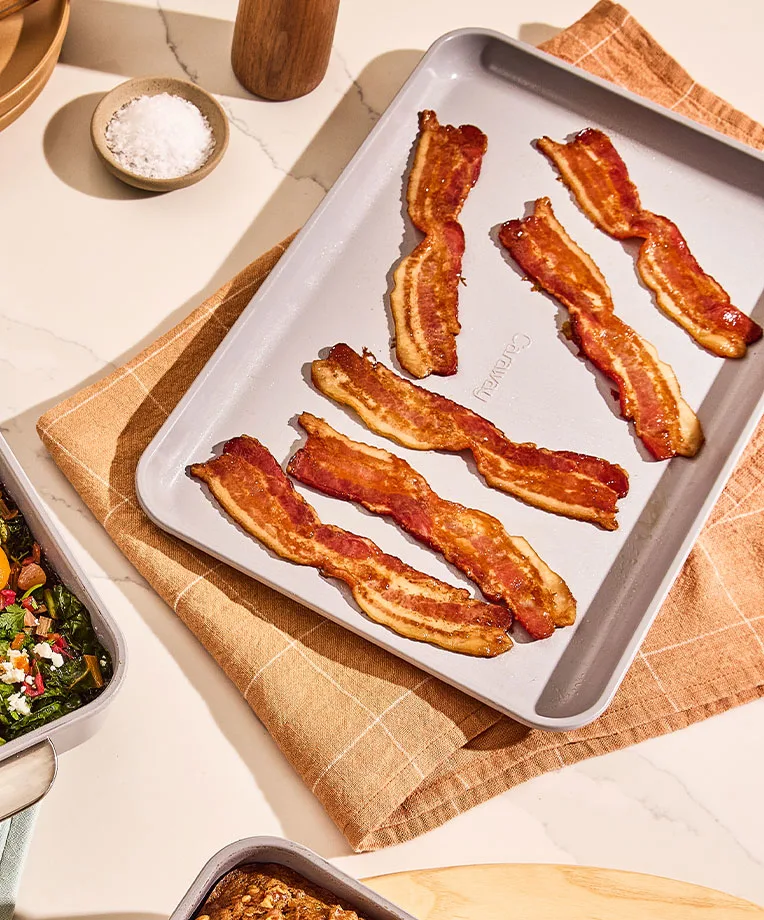
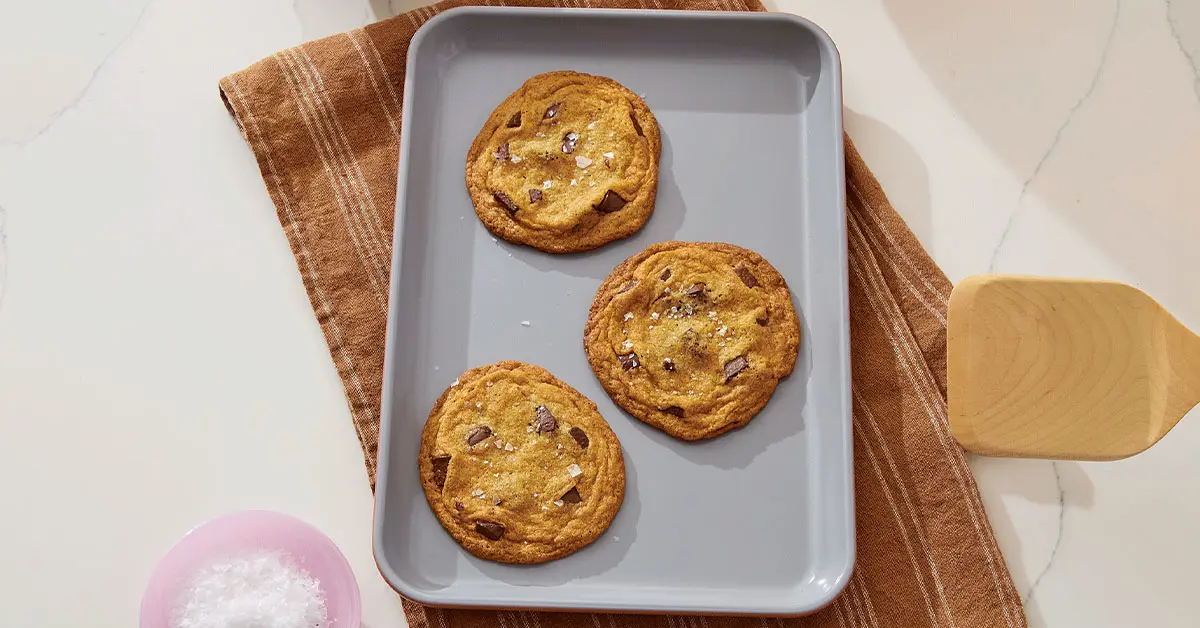
Our Baking Sheets are built on exactly that aluminized steel core, then finished with a ceramic coating. You get even heat distribution for consistent results, plus a naturally slick surface that lets food release cleanly.
Once you've settled on a solid metal base, the next question is what's on top of it. Traditional nonstick baking sheets rely on coatings made with PTFE (the material behind Teflon), which belongs to the family of forever chemicals linked to a range of health concerns . When those coatings scratch or overheat, that's not something you want near your food.
A ceramic coating gives you the same easy-release convenience without any of that baggage. It's mineral-based, so there's no PTFE, PFOA, or PFAS involved, and food slides right off with barely any oil. That means less scrubbing, less parchment paper, and less worry about what's leaching into your roasted vegetables.
This matters more than people realize, because research has shown that cookware materials can transfer metals and other substances into food during cooking, particularly with cheaper or damaged surfaces.
A quality ceramic coating that's third-party tested takes that question off the table entirely. Every piece in our bakeware line is tested for over 200 types of PFAS and 20+ heavy metals, which is the kind of transparency worth looking for from any brand.
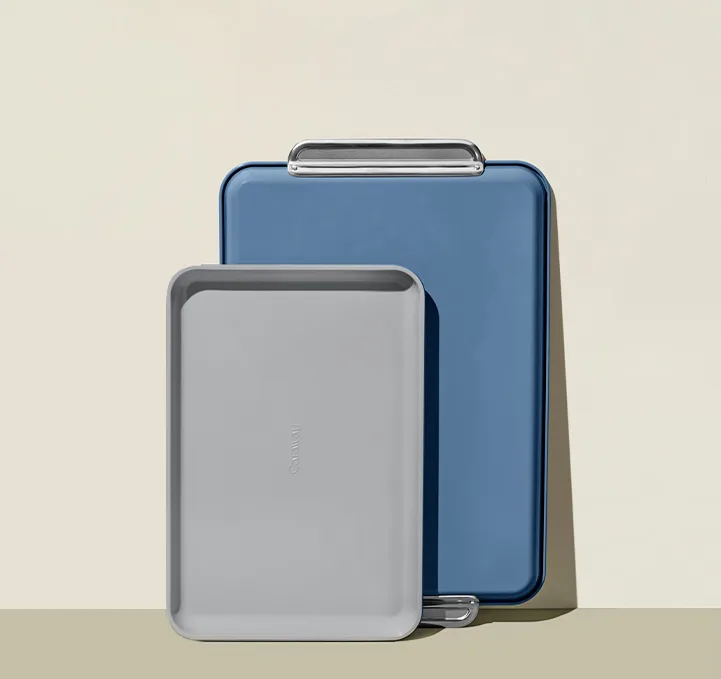
Baking sheets come in different sizes for a reason, and owning more than one size makes your life significantly easier.
The most versatile option is the half-sheet size (around 18x13 inches), which fits comfortably in most home ovens and handles the majority of what you'll bake. But smaller sizes earn their place, too. A quarter-sheet is perfect for toasting a handful of nuts, roasting a single portion of vegetables, or oven-to-table appetizers.
The real advantage of owning multiple sheets comes down to airflow. When you crowd too much food onto one pan, it steams rather than roasts, and you lose that golden-brown crispness. Having two sheets means you can spread food out properly for better browning. Our Baking Sheet Duo pairs a large and medium sheet for exactly this reason, so you can split a big batch across two pans instead of piling everything onto one.
There's also a fun level of versatility here. A good half-sheet pan isn't just for cookies. Bakers use them for everything from sheet cakes to perfectly flat layer cakes , roasted dinners, granola, and more. One well-made sheet quietly becomes the most versatile pan in your kitchen.
It might sound like a minor detail, but the color of your baking sheet genuinely affects how your food bakes. Dark-colored pans absorb heat more efficiently than light-colored ones , which means food browns faster on a dark surface.
That's an asset for some things and a problem for others. If you're after deeply browned, crispy edges on roasted potatoes or a well-set crust on pizza, a darker pan helps.
But for delicate items like cookies, cakes, and pastries, a dark pan can brown the bottoms and edges too quickly, sometimes before the center is even done. The result is burnt edges or a domed, unevenly baked cake.
Lighter-colored pans give you more even, gentle browning, which makes them the more forgiving all-around choice, especially for baking. If you tend to bake more than you roast, a lighter surface will give you more consistent results with less babysitting.
Now that you know the big factors, here's a quick checklist to run through before you buy:
Heavy-gauge construction. Thicker pans resist warping under high heat. If a baking sheet feels flimsy or lightweight in your hand, it'll likely buckle in a hot oven.
Rolled or reinforced edges. A rolled steel rim adds strength, keeps the pan from bending over time, and gives you a sturdy edge to grip.
Even heat distribution. This comes back to material. Aluminized steel is your best bet for consistent, hot-spot-free baking.
A trustworthy nonstick surface. Look for a ceramic coating free of PFAS, PTFE, and PFOA, ideally backed by third-party testing you can actually see.
A size that fits your oven and your cooking. Measure your oven's interior before buying, and consider grabbing more than one size for flexibility.
Easy storage. Baking sheets are awkward to store, so a set that nests or comes with a storage solution keeps your cabinets from becoming chaos.
If you're refreshing your kitchen or starting from scratch, a baking sheet is one of the smartest first buys. From there, it's easy to build out a full collection as you go.
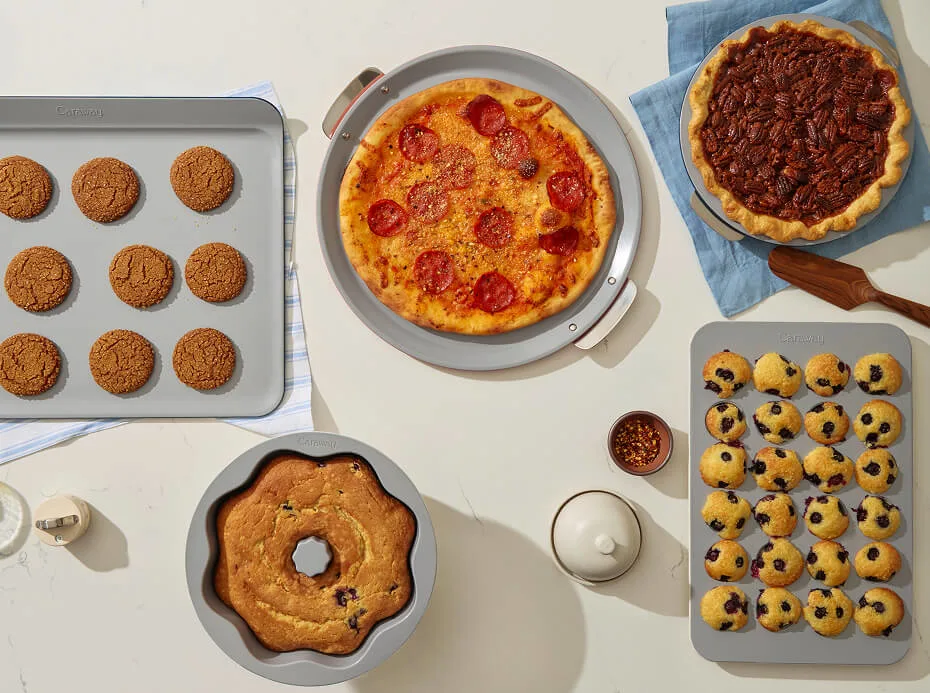
For most people, starting with a versatile duo covers the essentials. If you bake often or cook for a crowd, our full Bakeware Set rounds things out with muffin and loaf pans, plus other pieces you'll reach for regularly, all built with the same aluminized steel core, ceramic coating, and included storage. It's an easy way to get a matching, non-toxic set in one shot rather than piecing it together over time.
The best baking sheet comes down to a few fundamentals: heavy-gauge aluminized steel for even, warp-free heating, a ceramic coating that skips the forever chemicals, a size (or two) that fits how you actually cook, and a color that matches what you bake most. Nail those, and you've got a pan that turns out better food and sticks around for years.
Ready to upgrade? Our Baking Sheets are third-party tested, built to last, and designed to make everything from weeknight sheet pan dinners to weekend cookies come out just right.
Aluminized steel is widely considered the best material because it combines aluminum's even, responsive heating with steel's durability and warp resistance. It heats consistently, resists bending under high heat, and lasts for years, which is why it's the go-to for both professional and home bakers.
Quality ceramic-coated baking sheets are made without PFAS, PTFE, or PFOA, which makes them a great non-toxic option compared to traditional nonstick. Look for a brand that provides third-party testing, since that's your proof that the coating is actually free of forever chemicals and heavy metals rather than just labeled that way.
The half-sheet size (around 18x13 inches) is the most versatile and fits most home ovens, making it the best single pan to start with. That said, owning more than one size gives you flexibility, since spreading food across two pans improves browning and airflow compared to crowding everything onto one.
Warping usually occurs with thin, lightweight pans that can't withstand high heat or sudden temperature changes, such as rinsing a hot pan under cold water. Choosing a heavy-gauge aluminized steel sheet and letting it cool before washing are the two best ways to prevent it.
Sources:
Lighten Up (Your Cake Pans) | America's Test Kitchen
Things Bakers Know: Bake Your Layer Cakes in a Sheet Pan | King Arthur Baking
Forever Chemicals (PFAS) and Your Health | Cleveland Clinic
Assessing Leaching of Potentially Hazardous Elements from Cookware During Cooking | PMC
Spend $675 to unlock your gift!
$90
Free Shipping
$675
Baking Sheet Duo
($120 Value)
Get started with the Caraway essentials!
Free Shipping On Orders $90+
Free Returns
30-Day Trial
Spend $675+ to unlock your free gift!
Exclusive Baking Sheet Duo for orders $675+
$90
Free Shipping
$675
Baking Sheet Duo
($120 Value)
Spend $675+ to unlock your free gift!
Exclusive Baking Sheet Duo for orders $675+
$90
Free Shipping
$675
Baking Sheet Duo
($120 Value)
