Your Cart is Empty
Get started with the Caraway essentials!
Free Shipping On Orders $90+
Free Returns
30-Day Trial
Home & Kitchen with Caraway
Key Takeaways
Pan warping is most often caused by thermal shock—sudden temperature changes that force metal to expand or contract unevenly.
Heating gradually and letting pans cool before washing are two of the easiest ways to keep your cookware flat and functional.
Well-constructed cookware with thick bases and even heat distribution is far less likely to warp over time.
Pans tend to warp due to thermal shock and uneven heat. A warped pan creates uneven contact with your stovetop, which means inconsistent heat, unpredictable results, and a lot more babysitting at the stove.
At Caraway , we think your cookware should work with you, not against you. So, let's get into what causes warping, how to prevent it, and when it's time to move on.

The biggest culprit in warping is thermal shock . When metal heats up, it expands. When it cools, it contracts. That's totally normal and fine, unless it happens too fast.
Running a hot pan under cold water forces one side to contract rapidly while the other is still expanded, and that tug-of-war between temperatures physically bends the metal. The same thing can happen in reverse, too. Placing a cold pan straight from the fridge or sink onto a screaming-hot burner creates the same kind of stress on the material.
Cranking your burner too high might feel like a time-saver, but it's tough on your cookware. When the center of a pan heats up significantly faster than the edges, that uneven expansion can cause the base to bow or buckle .
Thin or poorly constructed pans are especially vulnerable here, since they don't have enough material to absorb and distribute that heat evenly. Gas burners and electric coils, which concentrate heat in specific areas, can make the problem worse.
Start on low or medium heat and let the pan warm up gradually before increasing the temperature. Our ceramic cookware is designed to hold heat efficiently, so you really don't need to push past medium for most everyday cooking.
After cooking, set your pan aside and let it return to room temperature on its own before washing. A gentle hand wash with warm, soapy water is all it takes.
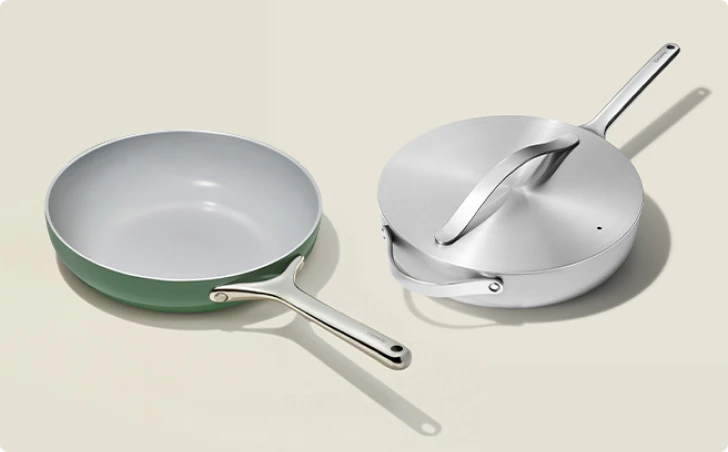
Construction matters. Pans with thick, well-bonded bases distribute heat more evenly and are far more resistant to the stress that causes warping. Our cookware is thoughtfully constructed with an aluminum core and stainless steel base plate and is built to handle everyday cooking without losing its shape.
These statements have not been evaluated by the Food and Drug Administration. This product is not intended to diagnose, treat, cure, or prevent any disease.
In some cases, a mildly warped sheet pan can be gently reshaped, but for most cookware, warping compromises the structural integrity of the metal. Replacement is usually the better call.
Not always, but consistently cooking on high heat increases the risk significantly. Low to medium heat is gentler on your pans and often all you need.
Thin aluminum and lightweight nonstick pans tend to warp most easily. Thicker, multi-layered construction (like stainless steel clad with aluminum) holds up much better over time.
Sources:
You're Probably Ruining Your Pots and Pans—Here's Why | Reviewed
Why Pans and Baking Sheets Warp & How to Easily Fix It | Prudent Reviews
Avoiding a Warped Pan: All You Need to Know | Skottsberg
What Is Thermal Shock? How to Protect Your Cookware | Circulon
Get started with the Caraway essentials!
Free Shipping On Orders $90+
Free Returns
30-Day Trial