Add $675+ to unlock your free gift!
$0
$90
Free Shipping
$675
Airtight Duo
($125 Value)
Your Cart is Empty
Get started with the Caraway essentials!
Free Shipping On Orders $90+
Free Returns
30-Day Trial
Home & Kitchen with Caraway

Key Takeaways
PFOA-free only means one specific chemical is absent, but the cookware can still contain PTFE or other PFAS compounds.
PFAS-free is the strongest safety claim and means none of the thousands of chemicals in the forever chemical family are present.
Ceramic-coated cookware is the easiest way to avoid PTFE, PFOA, and PFAS entirely without sacrificing nonstick performance.
Are you intrigued by PFOA-free cookware? Read on to learn more about what PFOA is, the purpose of PFOA-free pans, and the many benefits of cooking without PFOA.
When shopping for the perfect essentials and accessories for your kitchen, you've probably stumbled across cookware with the words "PFOA-free" scrawled across it. The invention of PFOA and its usage in cookware has a long and storied history that is still impacting our health today.
To learn more about PFOA and what it has to do with cooking, keep reading.
Every Caraway product is third-party tested for over 200 types of PFAS and 20+ heavy metals . Testing reports are available upon request. We don't just make claims about what's not in our cookware. We prove it.
PFOA, or Perfluorooctanoic acid, is a manufactured chemical that is created as a byproduct of producing fluoropolymers. Because of the properties of PFOA, it has often been used to make products that are designed to resist heat, water, grease, and sticking.
Among these products is a famous one: non-stick cookware. The process of creating these unique surfaces is fascinating. The answer lies in the coating, which sometimes uses PFOA.
While PFOA may sound useful for solving a kitchen-cleaning headache, it has a major downside.
Unfortunately, the chemical that brought you non-stick cookware also brings some health concerns worth being aware of.
Many studies have found that exposure to high levels of PFOA could affect growth and development, reproduction, and damage the liver. These health conditions include (but are not limited to) kidney and testicular cancer, thyroid disease, liver damage, and cholesterol concerns.
PFOA is known to persist and not break down in the environment and has also been identified in bodies of water, land, and animals. It exists all around us and can easily be consumed by people.
This information about the health conditions associated with PFOA is enough to set off alarms. To avoid these health threats, it's best to avoid PFOA altogether. However, that can be difficult to do when it seems so prevalent in the kitchenware aisles.
In 2006, the EPA launched the PFOA Stewardship Program, asking eight major manufacturers to eliminate PFOA from their products and facility emissions by 2015. All participating companies reported meeting that goal. So PFOA is largely gone from U.S. manufacturing.
The problem is what replaced it. Some brands transitioned to chemicals like GenX, a shorter-chain PFAS compound that was marketed as a safer alternative.
But early research has raised similar health concerns, and the EPA included GenX in its 2024 drinking water regulation alongside PFOA and PFOS. The takeaway: PFOA-free alone isn't a guarantee of safety, which is exactly why the PFAS-free standard matters.
So, what exactly does all of this have to do with cooking? As we briefly mentioned, PFOA has been used in some cookware to give it its non-stick quality. A very common type of cookware that has been known to use PFOA in its products is Teflon.
Teflon is the brand name for polytetrafluoroethylene (PTFE). This synthetic chemical is similar to PFOA in that it also causes health risks when consumed. Ultimately, all of the chemicals that are used in these cookwares are wonderful in that they give you that non-stick quality, but the bad does outweigh the good.
PFOA, PTFE, and other harmful polyfluoroalkyl substances (PFAS) can be consumed when people use these types of non-stick cookware. A common way that they can enter the body is through chipped or overheated cookware.
When cookware is scratched, the non-stick coating can flake off and be ingested during use. This can happen very easily, especially if you don't care for, clean, or store your cookware properly.
PFOA-free cookware is exactly what you would expect: cookware that has no PFOA. Luckily, PFOA and Teflon aren't the only things that can create non-stick kitchen products.
Some materials can provide a naturally frictionless surface for your cookware without the chemicals we discussed earlier and the harmful risks that come with them. One of our favorite materials for this is ceramic.
Ceramic provides a slick surface for your cookware and comes with so many benefits. At Caraway, our cookware is free of PFOA and PTFE, but it's also free of PFAS, cadmium, lead, and other toxic metals that would otherwise be found in non-stick cookware.
These three terms get tossed around like they're interchangeable, but they're not. The differences matter, especially if you're trying to make informed choices about what touches your food.
PFOA-free means just one chemical, PFOA, wasn't used. The pan can still be made with PTFE (Teflon) and other PFAS compounds. In fact, testing has shown that some pans labeled PFOA-free still contained PFOA as a byproduct of manufacturing. The label alone isn't always reliable. Caraway meets this standard: Yes.
PTFE-free means there's no Teflon-style synthetic fluoropolymer coating on the pan at all. This is a stronger claim because PTFE is the primary coating material that historically required PFOA (or similar chemicals) to produce. No PTFE means no synthetic nonstick coating. Caraway meets this standard: Yes.
PFAS-free is the most comprehensive standard. It means none of the thousands of chemicals in the PFAS family are present in the product. This is the claim that actually covers all the bases. Caraway meets this standard: Yes.
If you're looking for truly non-toxic cookware, PFAS-free is the standard to shop for.
Ceramic cookware comes with benefits that traditional non-stick cookware doesn't. But what exactly are those benefits?
Here, we highlight some of them.
Cooking with products that don't contain harmful chemicals is great, but the health benefits go beyond just that. Traditional non-stick cookware that has PFOA and other chemicals still doesn't offer the most reliable clean. Even though it's billed as non-stick, food sometimes still gets stuck.
The way around this is to make sure that your cookware is thoroughly greased. But using a lot of butter or oil in your cooking often isn't what people want to be doing. With ceramic cookware, though, you don't have to worry about that.
The ceramic material creates such a reliably slick surface that you don't have to choose between your food sticking or coating your pans in tons of greasy butter and oils.
With ceramic cookware, when you go to clean up your dishes, the food comes right off with just a bit of warm water, soap, and a gentle scrub. Because of this, your cookware doesn't have to endure intense scrubbing that can dull a lively evening or even cause your pans to chip. Plus, with less oils being tossed in, your food is healthier than ever.
A common issue with cookware is that the food doesn't end up cooking thoroughly. This is often due to the material that is used in the cookware.
If you're using any one of our items in our Cookware Set, you'll find that the surface heats up very evenly without any cool spots. This ensures that all of the food is cooked evenly and thoroughly, a quality that cast iron and stainless steel cookware often lack.
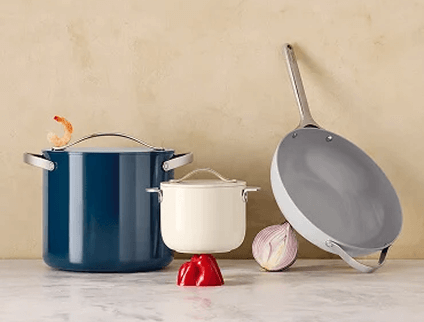
While some traditional non-stick cookwares also have this good heat conduction ability, they lack versatility. Our Cookware Set comes with four items — a Fry Pan, a Sauce Pan, a Dutch Oven, and a Sauté Pan. Each cookware item can function on any sort of stovetop, whether it be electric, induction, or gas.
On top of that, these four items are all you need in your kitchen in order to cook whatever you want. These items are so versatile that they can fit any of your cooking needs and can move right from your stovetop to your oven.
Additionally, the Cookware Set comes with a free Magnetic Pan Rack and Canvas Lid Holder for easy and convenient access to all your cookware. This safe (and aesthetically pleasing) storage solution, with proper care, results in products that last as long as you need them to.
The pop of unexpected color that our cookware can add to your kitchen is an added bonus that helps make intentional design and living even easier.
All of our cookware comes in a variety of colors, including Sage, Navy, Cream, Gray, Perracotta, Marigold, and, for a limited time, Brick Red. These colors are so vibrant that your cookware can even double as home decor.
A label is only as trustworthy as the testing behind it. Here's how to verify what you're buying:
Look for PFAS-free labeling, not just PFOA-free. The broader claim tells you more.
Check whether the brand publishes or shares third-party testing results. If they won't show you the data, that's worth questioning.
Be cautious with cookware made before 2013 or from brands with no manufacturing transparency. PFOA was still in widespread use before the stewardship program deadline.
Ceramic-coated cookware is the simplest way to avoid PTFE entirely. The nonstick surface comes from mineral-based materials, not synthetic fluoropolymers.
Between the versatility, the colors, and the non-toxic material, PFOA-free ceramic cookware is the way to go. With an option like ceramic, it's hard to imagine going back to the non-stick cookware that uses PFOA and other harmful chemicals.
Ceramic cookware is a slick solution to a sticky problem. Ceramic is part healthy eating, part easy cleaning, and part of a beautifully designed kitchen.
No. PFOA is one specific chemical within the much larger PFAS family, which includes thousands of synthetic compounds. A product can be PFOA-free and still contain other PFAS. PFAS-free is the more comprehensive claim.
It was phased out of U.S. manufacturing by 2015 under an EPA stewardship program. However, it may still appear in cookware produced overseas or in older products manufactured before the phaseout.
Some brands switched to alternative PFAS compounds, like GenX, a shorter-chain chemical that has raised its own health concerns in early research. Ceramic cookware avoids this entirely by using a mineral-based coating with no synthetic fluoropolymers.
Check for third-party testing documentation, look for PFAS-free (not just PFOA-free) labeling, and avoid pans made before 2013 from brands that don't disclose their manufacturing materials.
Yes. Ceramic coatings are made from natural, inorganic materials and don't use PFOA, PTFE, or any PFAS compounds. Our ceramic cookware is third-party tested for over 200 harmful substances to verify this.
Sources:
Perfluorooctanoic Acid (PFOA) Factsheet | CDC
How to Clean Ceramic Pans and Cookware | The Spruce
Fluoropolymer - an overview | ScienceDirect Topics
Per- and Polyfluoroalkyl Substances (PFAS) | EPA
Biden-Harris Administration Finalizes First-Ever National Drinking Water Standard | EPA
Fact Sheet: 2010/2015 PFOA Stewardship Program | EPA
PFAS: History, Current Concerns, and Future Outlook | PMC
Comparative Toxicokinetics of PFOA and GenX | PubMed
Best Frying Pans to Avoid PFAS Chemicals | Consumer Reports
Add $675+ to unlock your free gift!
$90
Free Shipping
$675
Airtight Duo
($125 Value)
Get started with the Caraway essentials!
Free Shipping On Orders $90+
Free Returns
30-Day Trial

Add $675+ to unlock your free gift!
Exclusive Glass Airtight Duo for orders $675+
$90
Free Shipping
$675
Airtight Duo
($125 Value)
Add $675+ to unlock your free gift!
Exclusive Glass Airtight Duo for orders $675+
$90
Free Shipping
$675
Airtight Duo
($125 Value)
