Almost there! You're $90.00 away from free shipping
Your Cart is Empty
Get started with the Caraway essentials!


Free Shipping On Orders $90+
Free Returns
30-Day Trial
Home & Kitchen with Caraway
Key Takeaways
Nearly all Americans have measurable levels of PFAS in their blood, but reducing exposure now means levels will drop over time.
The biggest sources of daily PFAS exposure are drinking water, food packaging, cookware, and household products treated for stain or water resistance.
You can't eliminate PFAS entirely, but targeted swaps in your kitchen, cleaning routine, and personal care products make a real difference.
PFAS (per- and polyfluoroalkyl substances) have earned the nickname "forever chemicals" because they don't break down in the environment and can accumulate in our bodies over time.
They've been linked to cancer, liver damage, thyroid disruption, immune suppression, and reproductive harm , and are found in an overwhelming number of everyday products. This includes cookware, food packaging, clothing, cosmetics, carpeting, cleaning products, and even dental floss. The list goes on.
The reality is that nearly every American already has PFAS in their blood . That sounds alarming, and it should.
The encouraging part is that once you reduce or remove the sources of exposure, your levels will decrease over time. You can't undo decades of contamination overnight, but you can make choices right now that meaningfully lower your daily intake.
At Caraway , avoiding PFAS is the foundation of everything we make. But a PFAS-free kitchen is just one piece of the puzzle.
Here's how to tackle the rest.
Drinking water is the single largest source of PFAS exposure for most Americans. PFAS have been detected in public water systems across all 50 states, and private wells are often untested entirely.
Find out what's in your water. If you're on a public system, contact your local utility and ask whether they've tested for PFAS. You can also check the EWG Tap Water Database to see what's been reported for your area.
Install a water filter that targets PFAS. Not all filters are created equal. Activated carbon filters and reverse osmosis systems are the most effective at reducing PFAS in drinking water. Standard pitcher filters may help with some contaminants, but they won't catch everything.
If you have a private well, get it tested. The EPA recommends regular testing, and your state environmental agency can point you to certified labs that use EPA-approved PFAS testing methods .
Your kitchen is one of the most direct points of daily PFAS contact, and it's also one of the easiest places to make high-impact swaps.
Traditional nonstick pans made with PTFE (the polymer in Teflon) are part of the PFAS family. When heated above 500°F, they can release toxic fumes strong enough to cause flu-like symptoms in people and even kill pet birds.
And don't be fooled by "PFOA-free" labels on nonstick pans. That often just means one specific PFAS chemical was swapped for another. Ceramic-coated cookware uses a mineral-based surface that's naturally slick without any PFAS at all. Our Cookware Set and Bakeware Set are both third-party tested for over 200 types of PFAS and 20+ heavy metals.
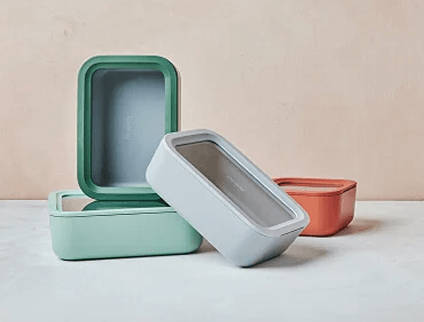
Plastic containers can leach chemicals into food, especially when heated. Glass containers with sealed lids are the safer option for storing and reheating leftovers. Our Food Storage Set is made with ceramic-coated borosilicate glass that's fridge, freezer, microwave, and oven safe.
This one's harder to control, but worth being aware of. PFAS have been found in fast food wrappers, microwave popcorn bags, and grease-resistant takeout containers . When possible, transfer takeout food to your own plates or containers instead of eating directly from the packaging. And skip the microwave popcorn bags in favor of stovetop popping.
PFAS show up in stain-resistant carpets, water-repellent clothing, cleaning products, and furniture treated with protective coatings. These chemicals can shed into household dust, which is especially concerning for young children who spend time on the floor and frequently put their hands in their mouths.
Avoid stain-resistant treatments. When shopping for furniture, rugs, or carpeting, skip the Scotchgard-type coatings and look for untreated fabrics in darker colors or materials that are naturally easy to clean.
Choose PFAS-free textiles. Organic cotton, linen, and wool are good alternatives for curtains, bedding, and kitchen textiles. Our Tea Towels , Cotton Aprons , and Pot Holders are all made from organic cotton with no chemical treatments.
Dust and vacuum regularly.
PFAS accumulate in household dust , so keeping surfaces clean with a damp cloth and vacuuming with a HEPA filter helps reduce what your family is breathing in and touching.
This is a category most people overlook. Some cosmetics, dental floss, shampoos, and nail polishes contain PFAS as part of their formulations. Products marketed as "long-lasting," "waterproof," or "smoothing" are more likely to contain fluorinated compounds.
Read ingredient lists and look for anything with "fluoro" or "PTFE" in the name.
Choose personal care products from brands that explicitly disclose PFAS-free formulations.
Be especially cautious with dental floss . Some popular brands use PTFE-based coatings to help the floss glide. Look for waxed options made without fluorinated materials.
Outdoor gear, rain jackets, and waterproof footwear are common sources of PFAS exposure. The same water-repellent coatings that keep rain off your jacket are often made with forever chemicals.
Some outdoor brands are actively reformulating to remove PFAS from their products, so it's worth checking before you buy. When possible, choose gear labeled PFAS-free or opt for naturally water-resistant materials like waxed cotton.
It depends on the specific compound. The four most studied PFAS have biological half-lives ranging from about 2 to 8 years , meaning it takes that long for your blood levels to drop by half after exposure stops. Reducing your intake now means levels will steadily decline.
Yes. PFAS blood testing is available and can tell you how much is currently in your body. The ATSDR and CDC provide guidance on what the results mean and what steps to take based on your levels.
Children may face higher exposure because they tend to put their hands in their mouths more frequently and spend more time on floors where PFAS-contaminated dust settles. Choosing PFAS-free products in your home is especially important if you have young kids.
Sources:
Preventing PFAS Exposure | ATSDR
How to Prevent PFAS Exposure | ATSDR
Perfluoroalkyl and Polyfluoroalkyl Substances (PFAS) | NIEHS
Meaningful Steps to Reduce Your Risk | EPA
Top 3 Ways to Reduce PFAS Exposure | EWG
PFAS Exposure Reduction | NCBI/NIH
10 Things You Can Do About Toxic PFAS Chemicals | Clean Water Action
Almost there! You're $90.00 away from free shipping
Get started with the Caraway essentials!
Free Shipping On Orders $90+
Free Returns
30-Day Trial