Your Cart is Empty
Get started with the Caraway essentials!
Free Shipping On Orders $90+
Free Returns
30-Day Trial
Home & Kitchen with Caraway
Key Takeaways:
Cobbler shakers are beginner-friendly with a built-in strainer, while Boston shakers offer more capacity and control for experienced home bartenders.
The best shaker for you depends on what you're making, how often you're making it, and whether you want simplicity or versatility.
Quality materials matter more than shaker style. A well-made stainless steel shaker will outperform a cheap version of either type every time.
You've decided to level up your home bar. Maybe you're tired of stirring margaritas with a spoon and hoping for the best, or maybe you hosted one too many dinner parties where the cocktail situation felt a little DIY in a not-cute way. Either way, you're shopping for a cocktail shaker, and you've hit the fork in the road: Cobbler or Boston?
Both have been around for over a century. Both will get the job done. But they work differently, feel differently in your hand, and lend themselves to different kinds of drink-making.
At Caraway , we think the tools in your bar should work just as hard (and look just as good) as the ones in your kitchen. So let's break this down properly, no gatekeeping, no snobbery, just the information you need to make a smart pick.

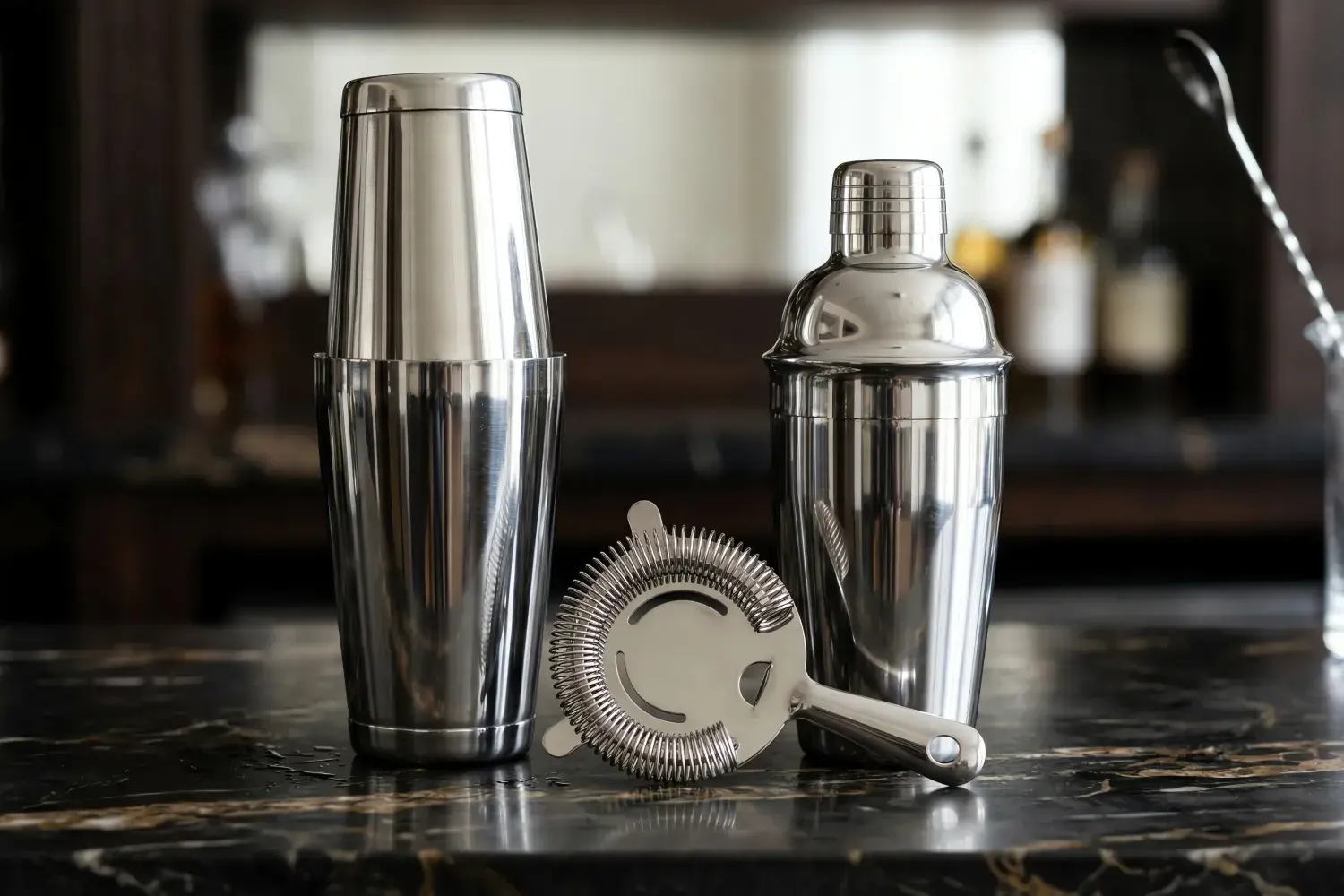
The cobbler is the one you've probably seen in movies, on bar carts, and in your parents' liquor cabinet. It's a three-piece shaker with a metal tumbler, a fitted lid with a built-in strainer, and a small cap on top that often doubles as a rough measuring tool (usually about one ounce).
The whole point of the cobbler is convenience. You pour your ingredients into the tumbler, pop on the lid and cap, shake, remove the cap, and strain directly from the shaker into your glass.
The cobbler has deep roots in Japanese cocktail culture , where bartenders are known for meticulous, one-drink-at-a-time service. There's something intentional about making a single cocktail with precision and care, and the cobbler lends itself to that philosophy. It's a design that's been largely unchanged since 1884, and there's a reason it's stuck around.
The Boston shaker is the two-piece setup you see professional bartenders using behind the bar. It consists of a large metal tin paired with either a smaller tin or a mixing glass. You build your drink in the larger tin, nestle the smaller piece on top at an angle, give it a firm tap to create a vacuum seal, and shake.
Unlike the cobbler, there's no built-in strainer. You'll need a separate Hawthorne strainer (and usually a jigger for measuring) to complete the process. That means more tools on the counter, but it also means more control over how you strain and pour. The Boston shaker is the industry standard for a reason: it's fast, efficient, easy to clean, and can handle bigger batches.
Now that you know the basics, let's put them side by side on the things that actually matter when you're making drinks at home.
The cobbler wins here, hands down. If you've never shaken a cocktail in your life, the cobbler's three-piece design is intuitive. There's virtually no learning curve. You pour, you cap, you shake, you strain. Done.
The Boston shaker takes practice. Learning to create and break the seal between the two tins (or tin and glass) requires a little technique. Get it wrong and you're wearing your cocktail instead of drinking it. But once you get the hang of it, the motion becomes second nature. Most people figure it out within a handful of tries.
Boston shakers are significantly larger. The standard large tin holds about 28 ounces, giving you plenty of room for ice, multiple ingredients, and even enough volume to shake two drinks at once. If you're hosting a group, this matters a lot.
Cobbler shakers are more compact, typically topping out around 16 to 24 ounces. That's fine for a single cocktail, maybe two if they're simple. But if you're trying to batch margaritas for six people, you'll be shaking all night.
The cobbler has a built-in strainer, which sounds like a perk until you actually use it. The strainer holes tend to be small and can get clogged by muddled herbs , fruit pulp, or ice chips. If you're making anything with fresh mint, citrus pulp, or egg whites, you'll probably end up reaching for a separate fine-mesh strainer anyway.
The Boston shaker requires a Hawthorne strainer by default, but that separate strainer actually gives you more control. You can adjust the tension, angle the pour, and fine-strain with a mesh sieve on top for an extra-smooth result. It's one more tool, but it's a better tool for the job.
This one goes to the Boston shaker. Two open tins rinse clean in seconds. The cobbler's three-piece design, with its built-in strainer and cap, has more crevices for sticky syrups and citrus bits to hide in. If you're making multiple rounds of drinks, that extra cleanup time adds up.
This is the cobbler's most notorious flaw. When you shake with ice, the metal contracts as it cools, and the lid can become extremely difficult to remove. Anyone who's ever wrestled with a cobbler shaker while guests are waiting knows exactly how awkward this gets. Higher-quality cobblers with well-machined parts are less prone to this, but it's still a common frustration.
Boston shakers can also get stuck, but a firm tap on the side of the larger tin usually breaks the seal immediately. The technique is faster and less of a production.
Let's be real, aesthetics matter when your bar setup is on display. The cobbler shaker has a sleek, Art Deco silhouette that looks incredible on a bar cart. There's a timelessness to it that the Boston shaker, which is essentially two metal cups, can't quite match.
That said, when you're actually making drinks for someone, watching a bartender work a Boston shaker has its own kind of cool. There's a rhythm and confidence to the motion that makes the whole thing feel like a performance.
Not all drinks need the same treatment. Here's a quick guide:
Simple shaken cocktails (daiquiris, gimlets, cosmos): Either shaker works beautifully. If you're making one at a time, the cobbler is perfectly efficient.
Drinks with muddled ingredients (mojitos, caipirinhas , smashes): Go Boston. The larger capacity gives muddled herbs room to move, and the separate strainer handles pulp much better.
Egg white cocktails (whiskey sours, clover clubs, pisco sours): Boston, no contest. You need the extra space for a proper dry shake (without ice first) to get that frothy texture, and the cobbler's small capacity makes this nearly impossible.
Batch cocktails for groups (margaritas, palomas, punch-style drinks): Boston all the way. The 28-ounce tin lets you shake multiple servings at once, which keeps the party moving.
Stirred cocktails (martinis, Manhattans , negronis): Neither. These should be stirred in a mixing glass with a bar spoon, not shaken. Shaking over-dilutes spirit-forward drinks and makes them cloudy.
Regardless of which style you choose, the quality of the stainless steel matters more than most people realize. Cheap shakers with thin walls dent easily, develop a metallic taste over time, and tend to have poorly machined seals that leak or stick. Rust-resistant 304 stainless steel is the gold standard for bar tools because it's durable, non-reactive, and won't corrode from citrus or bitters.
Our Complete Bar Set is built with exactly that. Six premium tools crafted from 304 stainless steel, designed for smoother pours, cleaner prep, and long-lasting performance.
The whole set comes with a modular birch wood storage base and display-worthy backer, so your tools stay organized and look good on the counter, whether you're mid-pour or just showing off your bar cart. If you're building a home bar from scratch, having everything in one cohesive set means you're not cobbling together mismatched pieces from five different brands.
Here's the honest answer: it depends on how you drink.
Go with a cobbler if:
You're new to making cocktails at home and want something straightforward
You typically make one or two drinks at a time
You stick to simple shaken recipes (margaritas, daiquiris, sidecars)
You want something that looks elegant sitting on your bar cart
You don't want to buy a bunch of extra accessories
Go with a Boston shaker if:
You're ready to develop real technique and grow your skills
You host often and need to make multiple drinks quickly
You love cocktails with fresh herbs, egg whites, or muddled fruit
You want easier cleanup between rounds
You plan on investing in a proper set of bar tools
And honestly, if you're serious about your home bar, owning both isn't a bad move. Use the cobbler for relaxed weeknight drinks and the Boston for when you're playing host and want to move efficiently.
No matter which style you go with, a few small habits make a big difference:
Always shake with the tin pointed away from your guests. Seals can break. It happens to everyone.
Use fresh ice every time. Old, melty ice dilutes your drink before the shaking even starts.
Shake for 10 to 15 seconds. That's typically long enough to chill and dilute properly. Over-shaking waters things down.
Dry shake first for egg white cocktails. Shake without ice to emulsify the egg white, then add ice and shake again for the chill.
Clean your shaker between drinks. Residual flavors carry over, and nobody wants a hint of last round's old fashioned in their espresso martini.
Hand wash when possible. Especially for stainless steel tools. Dishwashers can dull the finish over time.
The cobbler shaker and the Boston shaker both have their strengths, and picking the wrong one isn't going to ruin your cocktails. But picking the right one for how you actually use your home bar will make the whole experience feel smoother, faster, and a lot more fun. Start with what matches your comfort level, invest in quality materials that will last, and build from there.
You can use it for most shaken cocktails, but it struggles with drinks that have muddled ingredients (the strainer clogs) and egg white cocktails (not enough room for a proper dry shake). For those, a Boston shaker is the better tool.
Speed and efficiency, mostly. It's easier to clean between drinks, holds a larger volume, and the separate strainer gives more control over the pour. In a high-volume bar setting, those advantages add up fast.
At a minimum, a Hawthorne strainer and a jigger for measuring. A bar spoon, muddler, and fine-mesh strainer are also worth having if you want to make a wider range of cocktails. A complete set that includes all of these is usually the most practical (and cost-effective) way to get started.
Sources:
In Defense of the Cobbler Shaker | PUNCH
Manhattan Cocktail: The Classy Drink with a Cherry On Top | Crescent.edu
Get started with the Caraway essentials!
Free Shipping On Orders $90+
Free Returns
30-Day Trial